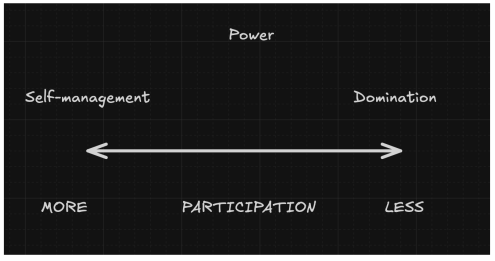
Credit: Bandeira Negra: rediscutindo o anarquismo, Felipe Corrêa
Co-op Cloud is a software commons, international federation and broad solidarity network which works towards a vision of democratic technology for everyone.
It’s a project which I’m deeply grateful for and have been involved in since the beginning. It is also a project which has no BDFL (Benevolent Dictator For Life). This is not a coincidence but the result of a strategic vision which suppressed the possibility of a BDFL.
My motivation here is to elaborate a critique of the BDFL model as an undesirable model for free software production because it severely limits participation. I hope this text and the Co-op Cloud project can serve as a useful reference for anyone looking for alternative models for free software production which cannot be not contained, captured or directed by a minority.
The relevant wikipedia page does a reasonable job of explaining exactly what we are talking about, via a Eric S. Raymond quote: “a single decision-making open source owner or maintainer”.
A BDFL controls all possible decisions to be made in a free software project: political, social and technical. That means we are not referring only to how the software changes but how we organise in and around the software.
This model is usually defended on technical grounds because a high level of technical expertise is perceived as required to sustain a project. The BDFL often possess those exact skills because they initiated the project.
It is common to see a pro-BDFL argumentation run along the lines of the rhetorical question “If I don’t do it, then who else will?”.
We might state the obvious and call it a day: A BDFL is bad because a dictator is bad. A benevolent dictator is still a dictator. However, the reality is that the BDFL model is the dominant mode for free software production.
If a BDFL is the “best person for the job”, has a proven track record of delivering results, then why not trust them? Am I some sort of bitter and impractical anti-authoritarian?
We must move past the persistent misunderstanding that an anti-authoritarian outlook must reject authority completely. I also consult the cobbler when it is a question of boots.
This is not an argument in defense of BDFL. A person with expertise can be consulted on a specific matter but it does mean they can impose themselves, deciding on the outcome for me, often for their own gain. This imposition expresses a power relationship of domination.
To unpack what I mean here, we need to have a shared definition of power.
All individuals, whether acting alone or together, have the capacity to bring about change in society: the potential to produce effects in the world. This capacity becomes a social force when it is put into action […]
Power relations are enduring patterns that emerge from the continual interaction and confrontation of social forces at all levels of society.
When one force, or a coalition of forces, overpowers others, it can more easily shape decisions, norms, and material outcomes.
– FVS, Educational material
We can define power in terms of a social relation and domination as a specific form.
Power is not the same as domination. Power relations are unavoidable wherever people organise and act together. Domination is a particular form of power relation, characterised by a lasting hierarchy: some impose themselves on others by taking control of decision making on matters that concern many or all, without genuine participation by the rest, and by enjoying the resulting privileges.
It is typically maintained through hierarchical institutions and expressed through command and obedience; control over collective resources and the fruits of labour; repression and punishment; dependence and alienation; and the shaping of a “common sense” that treats hierarchy as normal, favouring the dominators to the detriment of the dominated.
When we define power in terms of social relations and we understand these relations as emergent, then they are “in the room with us” when we organise with others. Claiming to destroy power is like trying to dig a hole in the ocean with a shovel. It cannot be done. How can we understand power then if we cannot seem to ever get rid of it?
Domination and self-management are directly related to the concept of power that will be defined here […], as asymmetry in the relations of force. Defining power in this way allows conceptualizing it, more specifically, as a relationship that is established in the struggles and disputes between different social forces, when one force(s) is imposed on the other(s);
The link between domination, self-management and power are given through the notion of participation; considering that participation is established by power relations, it may be greater, approaching the notion of self-management, or less, approaching the notion of domination.
Credit: Bandeira Negra:
rediscutindo o anarquismo, Felipe Corrêa
I am not claiming that BDFLs are “evil” or that free software projects managed by BDFLs have not had immense impact on society (e.g. Python). It would also be an overstatement to conclude that all decisions made and carried out result in privileges.
The goal of this text is not to demonise individuals but to argue against a specific organisational model. The BDFL model is a way of organising free software production which is characterised by domination, i.e. a lack of participation, lasting hierarchy and the imposition of a minority.
Let’s work through some of the most common problems and justifications.
How is free software produced and do the producers “owe us” anything? Should we as users “keep quiet and be thankful” that these software developers have blessed us with something we can use for free?
This antagonism will certainly not be solved by this text but I do believe we must try to establish a clear position in this debate. I don’t think we need to reinvent the wheel, this is the rejection of individualism in a new trench coat.
Free software is not produced in a vacuum but in a society. It is the result of discussions, motivations, aspirations and implementation that emerge in the context of a social environment which give shape to its political, social and cultural significance.
Free software developers are not “geniuses”, they are people who have had the privilege (e.g. access to 3rd level education or enough free time to hone their skills) to develop specific expertise and by applying themselves, produce free software which achieves a specific purpose.
This purpose is determined by the society in which it emerges, e.g. free software created for social need or profit. The tools, techniques, resources and reproductive care required to enable free software production is provided by society.
We shouldn’t need to mollycoddle free software developers who “deliver gifts from above” and see free software as the product of “a few great minds”. We can certainly be grateful for their efforts.
The problem starts when it is framed in the relationship of “giver and receiver” and this is weaponised. Free software developers may be extremely gifted but this does not make them exceptional.
Free software can be seen as a product of a society and it should therefore be shared in common, for the benefit of all. I’m not advocating for developers to sit day and night behind a keyboard in the service of random internet strangers. I’m proposing a different way of looking at equal participation in free software production.
Users, designers, documentation writers and participants of all kinds have something to offer. The initial creator of the free software should not unquestionably maintain a privileged position.
Businesses run by CEOs and worker owned businesses exist and they can produce useful things that we need. The former aims to limit participation of its own workers and exploit them. Where does the profit come from if workers are compensated completely for their work?
If we do not disconnect ethics and aesthetics, we can evaluate what is good based on different values. Beyond a purely technical standpoint, we can for example consider whether or not this model leads to exclusion and exploitation.
The BDFL model always produce exclusion. Participants, users (willing or unwilling) and often fellow developers face a very real glass ceiling in their ability to participate in the decisions that affect them.
An example of how exclusion becomes exploitation is when free software is then rolled out against the wishes of entire cities (do you remember “Smart Cities”) or even entire countries and regions (so-called “AI”).
What is to be gained “at the expense of others” in the context of BDFL-managed free software production? If a BDFL overworks themselves all weekend to release a new version, shouldn’t we be thankful?
This might seem easy to answer when it is a commercial project but when the software is produced completely voluntarily and for no commercial gain? We can look beyond financial gain and at other immaterial benefits.
Established BDFLs often experience a high level of obedience (usually, for fear of being ostracized), unquestioning moral support, reinforcement of their perceived exceptionalism and a developing cult of personality through their platform.
The more popular a project, the more dominating power a BDFL wields: they determine how the involvement of an increasing number of participants looks like and how their support, resources and participation will be put to use.
We are struggling as a society to overcome the idea that “tech is too complicated”. This has left us in a position of talking about “non-technical people” (whatever that means) and those people performing a mea culpa of “I don’t know anything about technology” when they eventually dare to participate.
It doesn’t have to be this way.
I don’t know how to build and power a refrigerator, or program a computer, but I don’t know how to make a fishhook or a pair of shoes, either. I could learn. We all can learn. That’s the neat thing about technologies. They’re what we can learn to do.
Because “software is eating the world”, this dynamic extends to all sorts of different social domains where these “technical experts” are assumed to have insight.
[This situation] has allowed people with elite technical training, which is, of course, very gendered and very racialised, to have standing, to discuss the way that these products, these services, these infrastructures are shaping a vast array of variegated social and political domains… that frankly these people have no idea about.
A BDFL usually has an unquestioned technical ability and is considered to possess all the competencies required for a successful free software project. However, free software is more than the software and cannot exist without communities, infrastructure and everything else beyond the text files.
We can reframe the skills of the BDFL as incomplete because knowledge is never final. Everyone who wishes to participate has their own experience to bring to the table. A BDFL calling all the shots will necessarily deliver a less useful free software due to the limits of their understanding.
If a supposedly radical and liberatory free software project is run by a BDFL then their means and ends are usually not in alignment. A project cannot authentically (multiple dictators is also not desirable) promote decentralisation while being run by a dictator.
If means and ends are not in alignment, you are not moving towards your goal but moving away from it, ending up in an unintended final destination and often reproducing harm.
The alternative to domination is self-management.
It is a model of free software production which seeks to constantly expand participation and decision-making. It promotes political and social equality and a shoulder-to-shoulder culture of solidarity and mutual-aid. It articulates a bottom-up vision of collective free software production which is diverse, inclusive, resilient and effective.
As far as I can tell, we’re still lacking a name for this model (or models?) but that has not stopped many projects organising themselves without a BDFL. It is my experience that such projects can deliver more creative, technically innovative and altogether more useful free software through expanded participation.
I can share briefly below how Co-op Cloud has strategically suppressed the BDFL model. Since day 0, Co-op Cloud has articulated the need to develop a democratic organisational model.
Place democratic governance at the core of the project. We want to collaborate as much as possible with other co-operatives to build up effective decision-making structures so we can all rely on this project far into the future.
In State of the Co-op Cloud (2023), yours truly managed to arrive at a quite unhinged explanation of how Autonomic developed the project just enough to remove itself from the lead decision-making position.
We eventually ended up at the The Co-op Cloud Federation Proposal which was voted on and accepted by multiple participating collectives as they joined the project.
In Grow
Your Own International Democratic Tech Federation (2025),
@3wc elaborated a critique of how a “traditional and
nuclear model” for free software production means decisions must pass
through a single person who controls the means of administration.
These efforts and others have helped us end up in the current situation which is detailed on the Community page of the Co-op Cloud website.
One of the most important aspects of Co-op Cloud is our broad and international solidarity network of designers, critical thinkers, artists, activists, hackers, admins, programmers, documenters and more! Our network is the engine of continuity, diversity and the people power that is truly required to create real change in the field of digital technology today. We welcome everyone who shares affinity with our vision of democratic technology and can abide by our Code of Co-operation.
Coop Cloud is managed by an international federation (CCF) of over 20 democratic technology collectives including small-scale hosters, worker-owned cooperatives and nonprofit organizations based in Latin America, Australia, North America and Europe. The CCF is a living example of a constructive alternative to the BDFL (Benevolant Dictator For Life) model of software production. The CCF stands in opposition to the BDFL model and proposes itself as an alternative-in-progress: Collective Self-management For Life (CSFL).
We have even included this “as a feature” in our lateset grant application.
The Co-op Cloud federation is a democratically run international (semi-formal) organisation of 21 small-scale hosting collectives which is open for all to participate and serves as the engine of continuity for the software commons.
This offers a level of confidence for the Co-op Cloud project because it is not reliant on a single “benevolent dictator” or hosting collective and it is resilient due to the decentralised governance model: we do not need to repeat the A/I situation - if one collective is taken down, another will take its place because the underlying structure is not disrupted: the software commons, federation and solidarity network.
Please share other examples and I’ll add them here.
A similar problem remains permanently hanging in the air for social movements that struggle for change: how can they prevent cooptation, entryism or vanguardism (forms of appropriation and misdirection)?
Just like any other complex social organisation, things can go either way: actions undertaken can expand or restrict participation. The antidote is simple but the implementation is not: permanent self-education which teaches participants how to identify takeovers. All participants should be equally capable of identifying and contributing to suppressing these takeovers and maintaining broad participation.
Similarly for free software production, we must develop models which suppress the (re-)emergence of a BDFL. This must be an ongoing practice which is reflected in the structures that participants propose and implement.